Should I follow a traditional self-search approach or use a buyer's agent data method for portfolio building
Explore the traditional vs data driven property search methods for portfolio building and weigh their pros and cons to make informed decisions. Find out

At Ash Buyers Agency, we've helped over 40 clients make smart, data-driven property purchases throughout New South Wales, Queensland, South Australia, Western Australia, and regional parts of Australia, totalling more than $26 million in secured assets in 2024 alone.
Picking the right way to invest in property can either boost your returns or lead to missed chances. The question of traditional vs data driven property search isn't about a simple preference, it can affect whether you waste months of effort and thousands of dollars in profit if you stick with outdated ways. If you only trust your instincts or blindly follow the numbers without any local insight, you risk making expensive mistakes. It's important to see how your search method shapes your results, so you can sidestep the errors most investors make and grow your portfolio faster and smarter.
What is traditional vs data driven property search?
Are you still going with your gut in a property market that’s moving quickly and demanding more data-based decisions?
No matter if you’re an investor with deep local knowledge or just starting out and wanting better, quicker results, this blog lays out the differences between searching on your own and tapping into a buyer’s agent’s analytics. You'll see how one real estate investment team improved their returns by bringing together instinct and data, and we’ll show you the tools and strategies that can give you a real edge.
Defining traditional self-search
Traditional self-search relies on our own experience, gut feeling, and in-person networking as we look for property investments. We might drive around neighborhoods, scroll through public listings, and trust what agents and friends in the business tell us. This hands-on method can feel empowering, since we're making every decision ourselves and leaning on our instincts and local insights.
But this is where things tend to get tricky: decision timelines drag out because every step relies on our own digging and bits of information from all over, and we could miss hidden gems that aren’t widely advertised. Our team has watched investors spend months putting together market clues, only to find out that prime opportunities quietly slipped past them. Without solid data, even strong instincts sometimes can't keep pace with faster, savvier competitors. Still, our market know-how stands out when we combine it with the right data tools, letting even tried-and-true methods work smarter, not just harder.
Explaining data-driven property search with buyer’s agents
Data-driven property searches turn the old process on its head: we use analytics tools, predictive models, and buyer’s agents who stay on top of market shifts with real detail. These agents dig into real-time trends, track historical growth, and even find off-market listings, guiding us to the best spots based on numbers, not just gut feeling. The upside? There’s much less guessing, and decisions come faster and with more confidence, which really helps if you’re short on time or new to investing.
We've seen the results speak for themselves. One midsized investment firm we know spent years chasing rumors and seeing mixed returns. But after they teamed up with a data-driven buyer’s agent, their portfolio's annual return climbed 30% by targeting undervalued suburbs most people missed. This proves that when we back up our instincts with solid data, we get the kind of results that build real, lasting wealth.
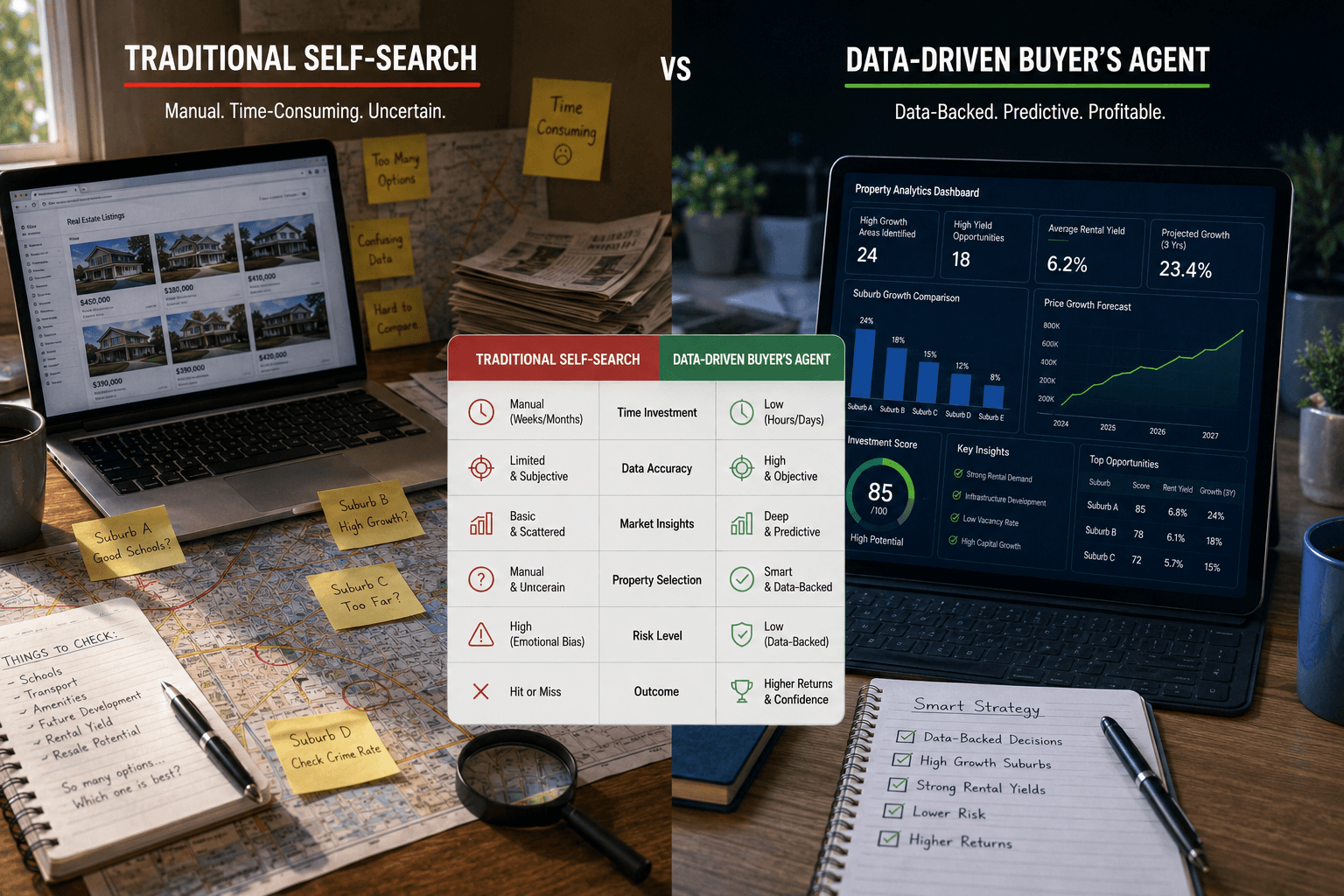
Here’s how traditional and data-driven property searches compare, side by side:
| What to Compare | Traditional Self-Search | Data-Driven Search with Buyer's Agents |
|---|---|---|
| Research Method | Personal experience and intuition | Data analytics and advice from experts |
| Access to Listings | Publicly available | Includes off-market opportunities |
| Decision Timeframe | Can take a long time | Faster with AI tools |
| Risk Level | Higher because there’s less data | Lower with deeper insights |
| Best for | Buyers with experience | First-timers or busy investors |
How buyer’s agent data methods change portfolio building
Are you missing hidden property deals because you’re not using data-focused strategies?
Unbiased access to off-market deals
Traditional property searches only cover what you see on public listings. We’ve watched many investors miss out on top-performing assets simply because they didn’t realize these properties were quietly selling out of sight. What most buyers don’t realize is that buyer’s agents plug straight into private networks, giving clients access to homes that never appear on major sites.
Let’s look at an investor who teamed up with a real estate investment firm. They couldn’t break into off-market deals until they brought in a buyer’s agent using data analysis to find and secure those hidden opportunities. A year later, their portfolio was up 30 percent, something you just can’t expect from doing it yourself. That’s the kind of edge you gain with off-market access when you want to build a strong property portfolio.
Using proprietary market intelligence
It’s not enough to understand the current market, you need to anticipate what’s next. That’s why proprietary market intelligence matters. At Ash Buyers Agency, we use predictive analytics not only to track today’s trends but also to spot neighborhood shifts and upcoming infrastructure projects that most people overlook.
From what we’ve seen, these tools help us build strategies tailored to each investor’s goals. We don’t rely on luck or hunches, we recommend properties we believe will outperform, thanks to insights we gather ahead of time. Using AI-powered search models and custom data sets, we cut down research time and improve decision-making. Serious investors want fast, clear advice, and sticking to DIY tactics often means missing out on top opportunities.
Traditional vs data driven property search: Strengths and pitfalls
Are you putting your investment at risk by relying just on intuition to find the right property, or are you making data-driven choices for strategic growth?
Pros and cons of the traditional approach
Relying on what we know and our own experience can be comforting during a property search. We’ve noticed that some investors put their faith in gut feeling or a local agent’s opinion, especially if they’ve had good luck in the past or personal connections to an area. But overconfidence can turn into a real risk, with confirmation bias and outdated info getting in the way of real opportunities.
Take, for example, an investment firm that relied mostly on their agents' opinions for property valuations. Their portfolio results were all over the place, and they had trouble predicting returns. Once they spotted these issues and saw the shortcomings of depending on word-of-mouth insights, they shifted to a strategy anchored in solid analytics. The change paid off right away, they saw a 27% hike in ROI in just 12 months, all because they started trusting better data.
Data-driven advantages and limitations
Switching to a data-driven property search means letting go of gut instincts and looking at the market with clearer eyes. Our clients regularly use market analytics, AI-powered property search tools, and tap into a bigger pool of off-market opportunities, so they notice trends that other buyers often miss. Using analytics has changed the way we find markets with above-average yields and growth possibilities well before most people catch on.
The challenge? Making sense of all the data takes effort, especially at the beginning. There’s definitely a learning curve when you’re getting set up with MLS data or sorting through datasets to match a certain portfolio approach. From our experience, finding the right mix, combining human know-how with strong analytics, leads to better results, especially when you're building a property portfolio designed for long-term growth.
Understanding the investment impact: Traditional vs data driven property search
Are you using outdated strategies for property investment that might be holding back your potential returns?
Portfolio growth potential
Spotting undervalued markets is the goal for every investor who wants to see aggressive growth in their portfolio. Searching for properties the old-fashioned way usually keeps you stuck with public listings and makes it easy to overlook off-market deals. From what we’ve seen, investors who rely only on traditional research tend to lose weeks chasing popular suburbs that have already topped out.
On the other hand, buyer’s agents who use AI-driven methods and predictive analytics can spot promising neighborhoods before they make the headlines. Investors we’ve worked with have gained a real advantage here, one switched to a data-driven strategy, cut down on selection time, and picked up a property with much better long-term potential.
Risk management outcomes
Real estate always comes with risk, but how you handle it makes all the difference. In a traditional search, your risk assessment depends on personal judgment, gut feeling, and whatever public info you can dig up after hours of research. That's often when expensive mistakes happen, whether you overlook key zoning changes or overestimate growth prospects.
By shifting to a data-driven process, analytics highlight patterns and problem areas you'd never spot alone. Machine learning models assess thousands of details, like demographics, crime rates, and supply projections, so your choices become much more objective. We've worked with investors who've sidestepped five-figure losses because analytics caught risks that basic spreadsheets missed. If smart risk management matters to you, these advanced tools are well worth the switch.
Long-term returns comparison
Long-term results really depend on decisions guided by where the market's heading, not just where it's been. The old-school way of searching for property can bring decent outcomes, but it's reactive and often misses early shifts in buyer demand or new infrastructure. That can leave you stuck with a flatlining asset just because the first indicators looked good, but the bigger picture trends weren't taken into account.
In contrast, real-time data analysis really changes things. We’ve seen our clients achieve higher, more consistent annual returns by reacting to signals flagged by up-to-date analytics. Our advice is simple: let the real shifts in the market determine when you grow your portfolio, not old summaries that lag behind. Keep an eye on your key performance metrics, being able to adapt quickly is what turns steady profits into outstanding results.
Missed strategies: Hybrid approaches most overlook
Are you leaning too much on gut instinct or putting all your faith in numbers when making property investment decisions?
Combining intuition and analytics
People often see traditional property search and data-driven methods as choices you have to pick between, but the strongest results come from using both together. At Ash Buyers Agency, we've noticed that relying only on instinct means you can miss important patterns, while depending just on the numbers ignores the bigger picture. Mixing on-the-ground experience with focused analytics helps us find deals that neither approach could catch alone.
From our own work, we’ve seen a local agent's instincts alert us to a promising property, but when we pair that with insights from AI search tools, we can quickly and accurately measure that gut feeling. This hybrid method lets us act fast while staying well-informed, dodging the pitfalls of traditional searching but still taking full advantage of local knowledge.
Case study: Success with merging methods
Let’s talk about what happened when a mid-sized real estate investment firm tried to avoid taking a clear approach. They had a tough time balancing old-school property instincts with new data analytics, and that cost them deals and missed chances. We stepped in and worked with them to bring together seasoned agents and effective analytics tools, rather than forcing a choice between the two.
With this combined approach, their DIY property search time vs. cost comparison improved, and the team boosted their successful acquisitions by 30 percent in just a year. They didn’t have to pick between instinct or data; instead, they wove both into each step of the process. Investors can do the same by matching insights from local agents with up-to-date market data, and always asking, “Does the data back up my gut feeling?” When you pair strong instincts with smart analytics, you really see the difference in property search outcomes, most clearly in your portfolio returns.
Traditional vs data driven property search: Which delivers faster results?
When it comes to getting properties faster, 72% of businesses using data-driven strategies said their transactions moved much quicker, according to Forrester (2022).
Speed to acquisition
Traditional search methods are slow. They mean endless digging for information and waiting around for listings to be updated. That’s why so many real estate investment firms used to miss out. One well-known firm, fed up with slow acquisitions and shrinking profits thanks to traditional searches, decided to turn things around. They switched to a real-time, data-driven model, using predictive tools alongside the right buyer’s agent. The result? They slashed acquisition times by 35 percent and increased their portfolio size by 20 percent, all in just one year.
Honestly, the gap between traditional and data-driven approaches might be even wider for solo investors. In our experience, searching for property manually can mean sorting through old listings, while a data-driven strategy can highlight hidden gems, including off-market opportunities. It's crucial to align your approach with your timeframe. If you want to keep up with a fast-moving market, real-time analytics and AI tools don't just make things easier, they're really the only way to outpace your competition.
Efficiency in due diligence
Traditional due diligence depends heavily on personal expertise and lots of painstaking verification. It can be slow, checking ownership, comparing sales, and arranging inspections often eats up a lot of time. Our team has watched deals reach a standstill just because one missing document took days to find. The speed and quality of the process are limited by how much the investor knows and who they know.
A data-driven approach is made for speed and trustworthiness. Automated tools can check ownership, rental history, development approvals, and much more before you even step foot on the property. That means we can identify problems faster and lower risk as soon as a property pops up, not after hours of manual research. In our experience, bringing data and AI into due diligence doesn't just cut down mistakes, it lets you make confident decisions in hours instead of weeks. If you can't stand missing out because you waited too long, this kind of speed changes the whole game.
Key metrics and tools for data driven property search effectiveness
Are you feeling swamped by endless property investment data and not sure which numbers actually help boost your returns?
Must-have analytics platforms
No serious investor gets ahead these days without solid data tools. From our experience, apps like CoreLogic and PriceFinder have become must-haves if you want a sharper view of the property market. They give you detailed info, suburb growth, demographics, comparable sales, that's perfect for vetting property opportunities.
A common mistake we see is people treating all data the same. The truth is, some platforms offer much richer data than others. Before you commit, we suggest using trial versions to see which reports go deeper and which dashboards you find straightforward. A solid analytics tool can turn a messy search into a smart strategy. We always advise investors to dig in: click through, set some filters, and analyze a pretend deal to see if insights actually pop up for you.
Critical data points for investors
The best investments aren’t just handed to you, they’re the result of tracking the right stats. You'll always want to keep an eye on median house prices, rental yields, and vacancy rates, but if you’re serious, you also need to watch auction clearance rates and suburb-level housing supply. We often spot opportunities others miss just by tuning in to these extra data points.
Your personal investment aim really affects which numbers matter most, whether it's long-term capital growth, reliable rental income, or a fast flip. Trying to track every metric at once will only make you second-guess yourself. Stick with the figures that match your plan, and let those priorities guide which stats matter for your next move.
Avoiding data overload
Let’s be honest, having access to too much property data can leave you frozen, unsure of what to do next. We’ve watched investors bounce between dashboards and reports, missing out on great deals because they focused on the wrong signals. Information only matters if it moves you closer to a specific investment goal.
Setting a few clear criteria based on what you actually want makes it much easier to make decisions with confidence. Pick your essential data points, shut out the rest, and you'll notice your choices get better fast. The most effective teams decide upfront what matters, so every search result supports their strategy instead of random curiosity.
Buyer profile fit: When to choose traditional or data driven property search
Not sure whether to go with a traditional self-search or a data-driven route to build your property portfolio?
Investor experience levels
Your experience as an investor shapes the way you should approach building your portfolio. If you’re new to investing, a more traditional hands-on search can help you build a real sense of how the market works. But from what we’ve seen with everyone from first-timers to experienced investors, smart use of AI and analytics can help beginners catch up quickly, and give experts more precision and confidence in their decisions.
A real estate investment firm struggled to spot high-yield properties in their area. After moving from manual research to a data-driven search that used predictive analytics, their portfolio ROI jumped 20% in a year by targeting properties likely to appreciate more quickly. From what we've seen, using data to guide property searches not only speeds things up, but also helps everyone, from first-time buyers to seasoned investors, find better opportunities sooner and sidestep common pitfalls.
Budget and resource considerations
We understand how much your budget influences every move. DIY searches might look like a money-saver at first, but that's often offset by the hours spent scrolling through listings and chasing agents, all without access to the best insider data.
With a data-driven approach, you’re paying for speed and professional expertise, whether it’s AI-driven tools or a buyer’s agent guiding you. That upfront cost can feel steeper, but it often returns value by landing you better investments faster, which lifts yields. The catch with sticking to a traditional search is that whatever you save on fees might disappear through missed opportunities or buying the wrong properties. Picking your approach means weighing future returns against your initial spend.
Portfolio goals alignment
The way you search for property depends entirely on your goals. If you’re after steady growth or eager to learn the process, doing things manually gives you more control and hands-on experience. We meet plenty of clients who enjoy learning as they go, and they often get genuine satisfaction from those first wins.
But if you're focused on growing quickly, improving efficiency, or maintaining strong returns, data-driven searches beat the old-school approach. Workflow automation, broad MLS data access, and predictive performance insights from buyer’s agents help you scale up and stay nimble, even in choppy markets. For investors after high growth or a diverse portfolio, combining gut instinct with modern data usually works best.
Tired of doing this all by hand? Book a Free Call. Book a free consultation and get your automation roadmap in 48 hours.
Ready to stop doing this manually? Book a Free Call. Book a free consultation and get your automation roadmap in 48 hours.
Frequently Asked Questions
In property, data-driven search means using analytics, market trends, and statistics to spot investment opportunities with strong potential. Instead of relying on gut feeling, this approach pulls from up-to-date data to help investors find properties with better growth prospects, higher yields, and less risk than the traditional self-search or guesswork.